Water in the Bilge
Our Real Leak Hunt, Plus Everything You Need to Know About Bilges and Bilge Pumps
Water in the bilge is one of the most common things a new boat owner panics about, and honestly, most of the time it's not the disaster it feels like. But sometimes it is a real problem hiding behind a boring explanation, and the only way to know which one you're dealing with is to actually track it down. That's exactly what happened to us on Sailing Bolongo, and it turned into one of the biggest jobs we've done on this boat.
Here's our story, and everything we now know about bilges, bilge pumps, and where that water is actually coming from.
What Is a Bilge, Exactly?
The bilge is the lowest point inside the hull, the place where gravity sends any water that gets into the boat, whether that's rain, spray, condensation, or a leak. Every boat has one. A small amount of water sitting in the bilge isn't automatically a crisis, boats are wet environments and a bit of moisture finding its way down there is normal.
What matters is knowing why it's there, how much is showing up, and whether it keeps coming back after you pump it out. That's the part people skip, and it's the part that actually protects your boat.
Our Story: Chasing a Mystery Leak From Purchase to Tunisia
When we were inspecting this boat before we bought her, we noticed water in the bilge almost straight away. It had clearly been there a while, and we flagged it as something to sort out before buying.
The owner was adamant it was coming from the corroded boiler. We needed to be sure it wasn't a hull leak, so we tasted the water. Fresh, not salt. The boiler was old and needed replacing anyway, so that explanation seemed reasonable. We asked the surveyor to check it during the survey. His report never mentioned it, so we went ahead with the purchase.
Once we'd settled into the area, we had a new boiler installed. The water in the bilge kept coming back. So it wasn't the boiler.
Finding the real source wasn't easy
We spent hours searching for the cause and came up empty. We brought in a plumber, recommended by another boat owner, who spent a full day swapping valves and making three parts runs. He overcharged us and, when I pushed back on the amount, became threatening. Being a woman alone on a boat with two kids in that moment was frightening, and I paid him to end the situation. I found the nerve afterward to tell him exactly what I thought of how he'd behaved. It was a stark reminder of how exposed you can feel as a solo parent on a boat, and a moment we got past, but it's part of the honest version of this story.
The next day we left for a trip to Manchester. As soon as I got back and filled the water tanks, the bilge was full again.
Since the water wasn't salty, we knew it had to be the tank system. In Tunisia, we started talking to other boat owners and eventually landed on the only real way to isolate the problem: check the tanks one by one, and if that didn't answer it, pull them all out and inspect the welds.
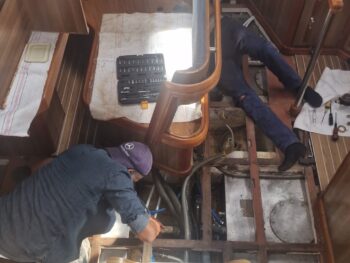
We found a contractor for a fair price and went for it. Getting the tanks out meant pulling the whole saloon apart, breaking out the floorboards and framing, and partially deconstructing the engine bay. The boat looked like a demolition site. Where the tanks had been sitting, there was black mold and a smell that made the scale of the job very real. I remember sitting there wondering if I'd made the right call keeping the kids aboard through this.
We were lucky to be in a marina with a strong liveaboard community. Friends checked on apartment availability for us (fully booked because of Eid), then offered us a night on their boat instead. Friends from @theadventurelocker turned it into pizza, games, and drinks, which did more for my headspace than anything else could have that week.
The next day, the crew finished the demolition and started rebuilding: cleaning, fiberglass, gelcoat, paint. The bilge came out white and fresh. Most of the original framework was rotten, so we had a full new frame built from Sapelli wood by a genuinely skilled carpenter.
Then came the tanks themselves. The welder inspected all five and found they'd been eaten through by electrolysis, tiny punctures scattered across every tank. Unrepairable, with no guarantee even a repair would last two years. Building new stainless tanks wasn't in the budget, so we went looking for alternatives: food-grade PVC tanks (too costly once you factor in custom molds) and eventually flexible water bladders, which turned out to be the practical fix, provided you build a proper system to keep them secured and protected from the bilge environment.
That whole saga started with "there's a bit of water in the bilge." It's why we take this stuff seriously now, and why we wrote the rest of this guide.
Where Does Bilge Water Actually Come From?
Our leak turned out to be corroded water tanks, but that's only one of many possible sources. If you find water in your bilge, work through this list before you assume the worst, or before you assume it's nothing.
Freshwater system
- Water tanks (corrosion, cracked fittings, failed welds, especially on older stainless or aluminum tanks)
- Water heater / boiler (a very common false alarm, like ours)
- Pressure pump, accumulator tank, and hose connections
- Pipe fittings and hose clamps that have worked loose with vibration
Saltwater and raw water systems
- Thru-hulls and seacocks (any fitting below the waterline: raw water intake, cockpit drains, head intake/discharge)
- Stuffing box / shaft seal (a traditional packing gland is supposed to drip slightly when the shaft is turning; a dripless seal shouldn't drip at all, so a sudden drip from a dripless system is a red flag)
- Rudder post / rudder tube seal
- Engine raw water cooling system: pump, hoses, heat exchanger, exhaust elbow
From above deck
- Hatches, portlights, and deck hardware with failed seals
- Chainplates and stanchion bases
- Anchor locker and chain locker drains
- Cockpit locker and lazarette drains
- Spray or rain entering through the companionway
Onboard systems
- Holding tank and head plumbing
- Air conditioning condensate drain
- Sink and shower drains, especially if a P-trap has failed
- Bilge itself sweating with condensation, common in humid climates or when a boat has been closed up
Structural
- Keel bolts or the keel-to-hull joint
- Hull-to-deck joint
- Any area with a history of osmosis or old repairs
If you only remember one thing from our story: taste the water. Salt versus fresh immediately cuts your suspect list in half.
Bilge Pumps and Pump Systems 101
Once you know where water is coming from, the next job is making sure your boat can handle it until you fix the source. That's what your bilge pump system is for, and it deserves more attention than most new owners give it.
Manual vs. electric pumps
Every boat should have both. A manual pump (like a Whale Gusher or Edson diaphragm pump) is your backup when the electrics fail or the battery is dead, and it should be operable from the cockpit in an emergency. Electric pumps handle the day-to-day, automatic work.
Centrifugal vs. diaphragm pumps
Electric bilge pumps come in two main types. Centrifugal pumps (the common submersible type, like a Rule pump) move a lot of water fast but clog easily on debris and can't run dry for long without damage. Diaphragm pumps are self-priming, handle small debris better, and can run dry without burning out, but they move less volume per minute. Many boats run a centrifugal pump as the primary and something more robust as backup.
Float switches and automatic activation
A float switch turns the pump on automatically once water reaches a set level. Traditional mechanical float switches are cheap but can stick or jam with debris over time, which is the single most common reason an "automatic" bilge pump fails to activate when it's needed. Electronic switches with no moving parts are more reliable and worth the upgrade if you're relying on your bilge pump while you're away from the boat.
Primary pump vs. emergency "crash" pump
Your primary pump handles normal seepage: rain, condensation, minor drips. A second, higher-capacity pump mounted higher in the bilge acts as a backup if water rises faster than expected, for example from a real hull breach. This is not a substitute for finding and fixing the actual leak. It buys you time.
Sizing your bilge pump
Pump capacity is rated in gallons per hour (GPH), but that number is measured with zero vertical lift. Real-world output drops once you factor in the height the water has to be pushed and the length and bends of the discharge hose, often by close to half. When sizing a pump, size up rather than trusting the number on the box.
The anti-siphon loop most boats are missing
If your bilge pump discharge hose runs below the waterline before it exits the hull, water can siphon back in through the through-hull once the pump stops, especially when heeled over. A vented loop (siphon break) installed above the waterline in the discharge line prevents this. It's a cheap, often-skipped fix that solves a surprising number of "my bilge pump runs constantly for no reason" mysteries.
Multiple compartments need multiple pumps
Boats with separate bilge sumps, common under the engine, in the aft cabin, or forward of a watertight bulkhead, need a dedicated pump in each compartment. Water in one sump won't reach a pump sitting in another, so check every low point on your boat, not just the main bilge.
How to Actually Diagnose Where Your Bilge Water Is Coming From
- Taste it. Salt means a below-the-waterline source (thru-hull, stuffing box, raw water system). Fresh means your water system, a leak from above, or condensation.
- Note when it shows up. Right after filling the water tanks points to the freshwater system. After motoring points to the stuffing box or raw water cooling. After rain or washing the decks points to a deck leak. Only underway and heeled over points to a thru-hull or siphoning discharge hose. Constant regardless of anything you do often means condensation or a slow structural issue.
- Check the stuffing box while motoring. A traditional packing gland should drip slowly, roughly a drop every few seconds. No drip at all can mean it's over-tightened and overheating the shaft. A dripless seal should not drip; if it does, that's a real issue.
- Isolate your tanks. Fill one tank at a time and check the bilge after each. This is exactly how we eventually found our leak, tank by tank, when nothing else worked.
- Dye test if you're still stuck. A few drops of food coloring in a suspect tank or system, then watch for color showing up in the bilge water.
- Physically inspect every thru-hull and hose clamp below the waterline while the boat is out of the water, or from inside every locker you can access.
Bilge Pump Maintenance Checklist
- Test every pump manually (via the panel switch) monthly, and test the float switch by lifting it by hand
- Clear debris, hair, and grime from the bilge and pump strainer regularly
- Check the discharge hose for a proper vented loop above the waterline
- Inspect wiring and connections for corrosion, especially at the float switch
- Confirm the manual backup pump is accessible and actually works, not just installed
- Know your pump's rated GPH and roughly how long it would take to keep up with a real leak at your boat's size
- After any haul-out or thru-hull work, re-test the whole system before you're back in the water
What We'd Tell a New Boat Owner
If a survey turns up water in the bilge, don't accept a convenient explanation, get an actual answer before you buy, or budget hard for finding out after. A calm story ("it's just the boiler") can be true and still be wrong. Taste the water, ask when it last appeared, and don't be afraid to ask the surveyor directly instead of hoping it makes the report.
And build a real relationship with your bilge pump system before you need it in an emergency, not after.
FAQ
Is a little water in the bilge normal? Small amounts of moisture from condensation or minor seepage are common on most boats. What matters is whether it keeps returning after pumping it out and whether you can explain where it's from.
How often should I test my bilge pump? At least monthly, and always before setting off on a longer passage. Test both the automatic float switch and the manual backup.
Can one bilge pump cover the whole boat? Only if your boat has a single bilge sump. Boats with multiple low points or watertight compartments need a dedicated pump in each one.
What's the first thing to check when bilge water shows up? Taste it. Salt or fresh narrows your search dramatically before you touch a single hose.
Learn more about boatsystems