Sparks in the Dark
What We Learned About 12V, 24V, 48V and 230V Boat Electrical Systems
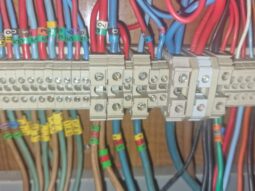
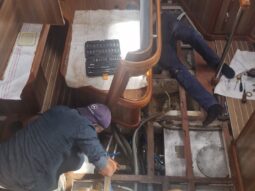
It was one of those ordinary days aboard, wind in the sails, sun on our faces, right up until the sky opened. Rain hammered the deck, and then came a sound that still makes my stomach drop thinking about it: a loud, sharp sizzle from somewhere behind the walls. I ran below and found rainwater tracking down through a deck fitting straight onto exposed wiring. Sparks. In the dark. Alone with the boys.
I cut every circuit I could find and sat there with my heart pounding, genuinely wondering if we'd just avoided a fire on our own boat. We patched it that night with extension cords and good intentions. But it was the moment I realized we didn't actually understand how our boat's electrics worked, we just used them.
Since then we've gone deep into it, and it turns out most boats are running two, three, sometimes four separate electrical systems at once, each with its own rules. Here's what we wish someone had explained to us before that night.

Why Boats Run Multiple Voltage Systems at Once
A boat isn't wired like a house. You've got a low-voltage system running your lights, pumps, and electronics whether you're at anchor or underway, and separately, a way to bring in "shore-style" power for heavier appliances and charging. Depending on the size of the boat and what's aboard, that can mean 12V, 24V, sometimes 48V, and 230V (or 110V, depending on where you are) all present in the same hull, on completely separate wiring, never meant to touch.
Understanding which system does what, and how they're supposed to connect to each other, is the difference between a boat that's genuinely safe and one that's one rainy night away from our night.
12V Systems: The Boat's Day-to-Day Backbone
For most cruising sailboats under about 45-50 feet, 12V is the core system. It runs the cabin lights, navigation lights, bilge pumps, water pumps, fridge, autopilot, chartplotter, and VHF, essentially everything you touch daily. It's powered by your house battery bank, kept separate from the engine start battery through a battery isolator or combiner so you can never accidentally flatten your starting power running the fridge overnight.
The catch with 12V is voltage drop. At low voltage, current has to be higher to deliver the same power, and higher current over a long cable run loses more voltage to resistance. That's why wire gauge matters so much on a 12V boat: a pump at the bow wired with cable that's too thin for the distance will run weak and hot, even if it tests fine on the bench. Every 12V circuit should be sized for both the load and the length of the run, not just the load.
24V Systems: More Common on Bigger Boats
As boats get larger, or carry heavier gear like bow thrusters, windlasses, or bigger inverters, 24V starts making more sense. Doubling the voltage halves the current needed for the same power, which means thinner cable can carry the same load over the same distance with less voltage drop. That's why you'll see 24V systems more often on bigger monohulls, catamarans, and anything with serious ground tackle or thruster power demands.
A 24V system isn't just two 12V batteries wired in series and left at that. It needs its own dedicated distribution, its own breakers rated for 24V, and its own charging sources. If a boat runs both 12V and 24V circuits (common when a windlass or thruster is 24V but the rest of the boat is 12V), that connection between systems needs a proper DC-DC converter, not a shortcut tap off the middle of a series battery bank. That kind of shortcut is exactly the sort of "should be fine" wiring that leads to boats like ours having a bad night.
24V Systems: More Common on Bigger Boats
As boats get larger, or carry heavier gear like bow thrusters, windlasses, or bigger inverters, 24V starts making more sense. Doubling the voltage halves the current needed for the same power, which means thinner cable can carry the same load over the same distance with less voltage drop. That's why you'll see 24V systems more often on bigger monohulls, catamarans, and anything with serious ground tackle or thruster power demands.
A 24V system isn't just two 12V batteries wired in series and left at that. It needs its own dedicated distribution, its own breakers rated for 24V, and its own charging sources. If a boat runs both 12V and 24V circuits (common when a windlass or thruster is 24V but the rest of the boat is 12V), that connection between systems needs a proper DC-DC converter, not a shortcut tap off the middle of a series battery bank. That kind of shortcut is exactly the sort of "should be fine" wiring that leads to boats like ours having a bad night.
48V Systems: The Newer Addition
48V is showing up more on boats with large lithium battery banks, solar arrays, electric propulsion, or big house loads like air conditioning and watermakers. The logic is the same as with 24V: higher voltage, lower current, thinner cable, less energy lost as heat over distance. For boats pushing serious power through big inverters or running electric drive systems, 48V is becoming the more practical standard.
It's still less common on a typical family cruising sailboat, but if you're refitting with lithium and adding real power-hungry gear, it's worth understanding before you commit to a voltage for the whole system, since retrofitting from 12V or 24V to 48V later means re-wiring, not just re-batterying.
230V (or 110V) AC: Shore Power and Inverted Power
This is the system that runs like the power at home: washing machines, air conditioning, battery chargers, and anything plugged into a normal wall socket. It comes into the boat two ways. Either directly from a marina's shore power pedestal through a dedicated shore power inlet and cable, or generated onboard by an inverter that converts your DC battery power into AC, or by a generator.
This is also the system that needs the most respect. Shore power AC absolutely must run on its own dedicated wiring and its own panel, physically separate from the DC system, with its own breakers sized to AC standards. A few things that should never be skipped on the AC side:
- A galvanic isolator or isolation transformer between the shore cable and the boat, to stop stray current from corroding your underwater metal (and other boats' metal, since marina wiring shares a common ground across the docks)
- An RCD or ELCI (residual current / equipment leakage circuit interrupter) to cut power instantly if current starts leaking somewhere it shouldn't, including through a person
- A clearly labeled, lockable main breaker so anyone on board can kill shore power in an emergency without hunting for it
If you're not entirely confident wiring AC yourself, this is the one system worth paying a certified marine electrician for. The margin for error is smaller and the consequences are bigger.
How These Systems Should Actually Be Connected
A few rules hold true across every voltage on the boat:
Keep AC and DC physically separate. Different wiring runs, different panels, different color coding. They should never share a conduit or a junction box.
Fuse or breaker as close to the source as possible. Every circuit should be protected right at the battery or panel it draws from, not partway down the run. That protects the wire itself, not just the device at the end of it.
Size the wire for the run, not just the load. The same appliance needs thicker cable at 12V than it would at 24V or 48V for the same distance, because of voltage drop. Undersized wire is one of the most common causes of overheating and, eventually, fires on boats.
Bridge voltages with a converter, never a shortcut. Mixing 12V and 24V devices on the same boat is normal, but the connection between them should always go through a proper DC-DC converter rated for the job, never a tap pulled off the middle of a series-wired battery bank.
Protect every deck penetration a wire passes through. Any cable that runs near a hatch, chainplate, stanchion base, or deck fitting needs a proper watertight gland and a drip loop, a low point in the cable run before it reaches a connection, so water travels down and off the cable instead of following it straight to a terminal. This is, almost word for word, the lesson our sparking night taught us.
Bond and ground correctly, but don't cross AC and DC to do it. Boats need a proper bonding system tying underwater metal together, and AC systems need proper grounding for safety. But AC neutral and DC negative should never be casually tied together outside of a correctly installed isolation setup. If you're not sure whether your boat's bonding and grounding is done correctly, that's worth a professional once-over, especially on a boat you didn't wire yourself.
Common Wiring Mistakes That Cause Sparks and Fires
- Wiring left exposed or unsecured near a hatch, deck fitting, or anywhere water can reach it
- No drip loop before a wire terminates at a connection
- Corroded terminals from years of salt air, quietly increasing resistance and heat
- Wire gauge too thin for the length of the run, especially common on 12V systems retrofitted with longer cable runs than they were designed for
- Missing or oversized fuses that don't actually protect the circuit they're on
- DIY "temporary" fixes, like our extension cord night, left in place permanently
A Simple Way to Think About It
Every system on the boat, whether it's 12V lights, a 24V windlass, a 48V lithium bank, or 230V shore power, comes down to the same three questions: is this wire sized correctly for this load and this distance, is this connection protected from water, and is this circuit fused close enough to the source to actually protect it. If you can answer yes to all three
FAQ
Do I need both 12V and 230V systems on a cruising boat? Most cruising sailboats run both: 12V (or 24V) for day-to-day systems, and 230V for shore power, chargers, and higher-draw appliances, connected through an inverter/charger.
What does a galvanic isolator actually do? It blocks stray DC current from traveling along your shore power ground wire, which otherwise accelerates corrosion of underwater metal fittings, props, and shafts, both on your boat and on neighboring boats sharing the same dock wiring.
Can 12V and 24V systems coexist on the same boat? Yes, but they need to be connected through a proper DC-DC converter rather than tapped directly off a series battery bank.
Is 48V becoming standard on boats? It's becoming more common on boats with large lithium banks, solar arrays, or electric propulsion, where the lower current at higher voltage makes big power draws more efficient. It's not yet standard on a typical family cruising sailboat.
Learn more about boat Systems