Haul outs and Dirty Hands
What to Know Before and During Your First Haul-Out
There's a version of the liveaboard life that looks like sundowners in an anchorage, boys jumping off the bow, golden light on the water. We post those pictures. We love those moments. But if we're honest about our first winter back in Monastir, most of it looked nothing like that.
It looked like grinding. It looked like dust in our hair and epoxy under our fingernails and two small boys asking for snacks while we were elbow-deep in something complicated. It looked like Reiss watching a YouTube tutorial at midnight on a repair neither of us had ever done before. It looked, most of the time, like hard work.
And we wouldn't trade it for anything.
On the Hard
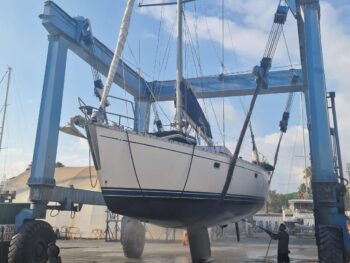
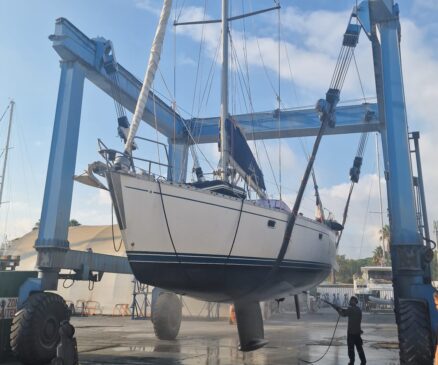
When sailors say a boat is "on the hard," they mean she's been lifted out of the water and is sitting on land, propped up on stands, exposed from keel to waterline. It sounds straightforward. It is not. Living on a boat on the hard means climbing a ladder to get home. It means no running water unless you rig it yourself. It means the boat rocks when the wind picks up, not the gentle sea rock you get used to, but a strange, stiff, land-locked shudder that feels all wrong.
We moved Bolongo onto the hard in Monastir with a list. Not a short list. The kind of list that makes a surveyor wince and a bank account cry. Throughhulls to replace. The rudder needed serious attention. We wanted to add a watermaker, a proper one, not a compromise. And the hull needed coppercoating, that dark antifouling treatment that protects the waterline and, if done right, means you're not scraping barnacles off every few months for the next few years.
None of us had done most of this before.
Before You Book the Yard: What to Check and Prepare
If we could go back and brief ourselves before that first lift, here's what we'd want to know.
Confirm your boat's exact lifting points and beam before you book. Travel lifts have weight and beam limits, and slings need to sit on the correct structural points, not just wherever looks convenient. If your hull has an unusual shape, a bulbous keel, a prop shaft, bow thruster tunnel, or anything non-standard, flag it with the yard in advance, not on lift day.
Book your slot well ahead of the season you actually need it. Good yards fill up fast, especially heading into winter layup season, and last-minute slots often mean worse positioning in the yard or a longer wait to actually get lifted.
Order parts before you arrive, not after. Shipping delays are one of the most common reasons a "two week" haul-out turns into two months. If you know you need throughhulls, zincs, antifouling, or specific hardware, get it ordered and ideally already at the yard before you're up on stands.
Plan your actual living logistics. Ladder access, no running water unless you rig your own supply, portable power needs, and where the nearest toilets and showers are if your own heads aren't usable while you're out. If you're doing this with kids aboard, this part matters more than any of the technical work.
Check what the yard includes versus what you're responsible for. Pressure washing, staging, waste disposal, and standing daily rates all vary. Ask before you're lifted, not when the invoice arrives.
Drain and secure anything that shifts weight unexpectedly. Full water tanks, loose gear, anything that could shift as the boat tilts during the lift itself.
Check you insurance policy
You want to absolutely sure what you are or aren't insured for when something goes wrong (we pray nothing) during haul out or when tradesman are working on your boat.
The Moment You're Lifted: What to Always Check
The few minutes your boat hangs in the slings, out of the water but not yet on stands, are genuinely valuable and easy to waste if you're not ready for them.
- Look at the hull below the waterline immediately, while it's still wet, before growth dries and becomes harder to read. Note any blistering, soft spots, or areas of heavier marine growth that might point to a weak spot in old antifouling.
- Check every throughhull and seacock for corrosion, and operate each one to confirm it moves freely.
- Inspect the prop, shaft, and cutless bearing for play, and check the condition of your zinc anodes, this is your main annual window to actually see them.
- Check the rudder for play or looseness. Ours had a wobble we could feel through the helm long before we ever pulled it, and confirming a haul-out is exactly the time to properly diagnose it.
- Look at the keel-to-hull joint and keel bolts for any staining, cracking, or signs of movement.
- Pressure wash promptly, while everything is still soft, rather than letting growth harden onto the hull.
What We Actually Replaced and Learned
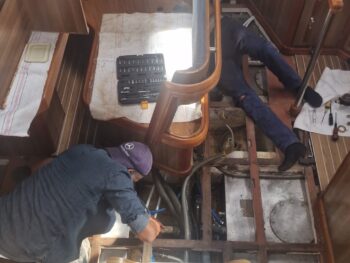
Throughhulls are the fittings that pass through the hull for engine cooling, bilge pumps, and the heads. When they fail, water comes in. Ours were original to the boat and long overdue. Reiss had read about the process, watched videos, talked to other sailors in the marina who'd done it before, and then did it himself, one by one.
The rudder was a different kind of problem. There was play in it, a looseness you could feel through the helm in certain conditions. Getting it properly diagnosed meant pulling it, a whole sequence neither of us had done before. We had help for that one, and it's worth saying plainly: the marina community in Monastir made this possible. People who'd been sailing for thirty years gave their time and knowledge without ever making us feel like the beginners we were.
The watermaker was the project we were most invested in practically. Fresh water isn't a given when you sail, and a good watermaker changes your range and your independence. Installing it properly, plumbed in, wired, tested, trusted, took longer than expected and went wrong in the specific way boat projects go wrong: not catastrophically, just incrementally, one small obstacle at a time.
Coppercoating the hull is not a one-afternoon job, it's a process. First you prepare the surface properly, which means properly, not approximately. Then coat after coat goes on below the waterline, a deep red-brown that hardens and protects for years if it's done right. It took days, and our boys, five and three at the time, were fascinated and occasionally underfoot, mostly interested in the biscuits we'd brought to keep them occupied.
Living When The Boat Is On the Hard: What Nobody Tells You
The marina at Monastir during winter has a working rhythm, different from the summer traffic of boats passing through. Most boats in winter are there for the same reason we were, maintenance, repair, improvement, the unglamorous work that makes the glamorous sailing possible. You get to know people. You borrow tools. You share problems. You eat lunch sitting on upturned buckets in the shadow of other people's boats and talk about throughhulls and antifouling and whether the weather will hold.
It is, in its own strange way, a lovely way to spend a winter.
The Moment She Goes Back In
There's a day, after weeks of work, when a boat goes back in the water. It is an absolutely nervewrecking moment. Ours went in on a morning in early spring, lifted by the travel hoist, that enormous machine that picks up boats like toys and carries them to the water's edge. We stood and watched. The boys stood with us. Bolongo came down slowly, touched the surface, and floated.
She sat perfectly. Fresh coppercoat at the waterline. Everything replaced, fixed, added, suddenly invisible beneath the hull, doing its job quietly, without any leaks or errors. We hadn't built the boat. We hadn't sailed her across an ocean. We'd done a winter's worth of maintenance, which isn't the stuff of legend. But we'd done it ourselves, mostly, in a language that wasn't ours, in a country that was new to us, with two small children and a list of repairs we hadn't known how to do when we started. A sigh of relieve and a pat on the shoulder.
FAQ
How long does a first haul-out usually take? It depends heavily on what's on your list and how quickly parts arrive. Ours stretched across a full winter once throughhulls, rudder work, a watermaker install, and coppercoating were all combined. A straightforward antifouling-only haul-out can take days rather than months.
What should I check the moment my boat is lifted out? The hull below the waterline while it's still wet, every throughhull and seacock, the prop, shaft, and anodes, and any play in the rudder. This is your best window all year to actually see these clearly.
Is coppercoat worth it compared to regular antifouling? It's a bigger upfront job and cost, but it's built to last multiple seasons rather than needing reapplication every year or two, which is exactly why we chose it for a boat we knew would be cruising hard.
Can you live aboard while your boat is on the hard? Yes, but expect real logistics: ladder access instead of a dock, no running water unless you rig it yourself, and a strange, stiff kind of rocking in wind that takes getting used to.
More Boat Systems to Explore