Sailing the Ionian
Best Anchorages, Greek Culture and Routes
Our Ionian season didn't start in Greece at all, it started in Syracuse, Sicily, where we nervously untied the lines and pointed Bolongo east across open water for three days straight. By the time Zakynthos came into view we were sunburnt, exhausted, and completely hooked. What followed was our first proper Greek season, and it turned out to be one of the most forgiving, most welcoming stretches of the Mediterranean we've sailed. Here's the real route, the anchorages worth knowing, the culture that makes this place what it is, and where to actually find your people out here.
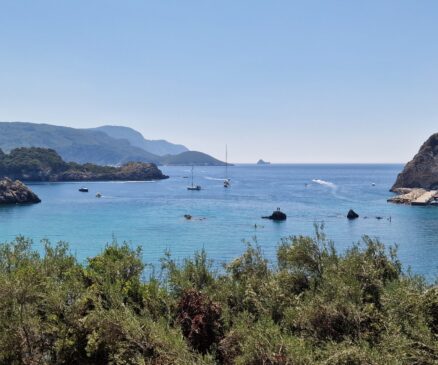
Our Route: Zakynthos to Corfu and Back
Zakynthos was our landfall after the crossing, and it gave us a welcome we didn't expect. Friends from @sailing4saga had been tracking our AIS signal on MarineTraffic and called us on the radio as we came in: "We see you! Follow us in!" They met us at the dock and talked us through mooring stern-to along the town quay, a maneuver we were still getting used to. That night was our first Greek gyros, hot pork, crispy fries, tomato, tzatziki, wrapped in warm pita. We ate them in every port after that.
Poros, Kefalonia came next, a quiet, welcoming port where the charm is entirely in the people. Local kids invited us to join their football game on the quay our first evening there, exactly the kind of simple moment that makes you feel instantly at home somewhere new. Practically speaking: Poros has excellent holding ground and easy quay access, watch for crosswinds funneling through the valley, and it's a good spot to restock from nearby minimarkets.
The Lefkada Channel was the nerve-wracking part. It's a narrow strip of water separating Lefkada from the mainland, crossed by a swing bridge that only opens once an hour. Timing it right matters, and we followed the channel buoys like our lives depended on it, queued up with other yachts waiting for the bridge to swing open. Tense, and genuinely thrilling once you're through.
Roda, on the northern tip of Corfu, was our longest single-day passage of the whole Ionian season, a bold call for us at the time, but worth it to meet old friends. Roda has a quiet beach vibe and relaxed locals, and yes, we celebrated with more gyros.
Gouvia Marina, back south from Roda, became an unplanned base camp when our watermaker got stuck in customs, a very Med-style delay. While we waited, we used Gouvia as a launch point for short trips to Paxos and Antipaxos, both of which became instant favourites: turquoise water, quiet coves, and a pace that made us properly slow down for the first time all season.
From there we sailed on to Preveza, reuniting with more cruising friends over grilled fish and homemade wine, with another quick escape out to Antipaxos for empty bays and total stillness. We ended the season in Argostoli, Kefalonia, where sea turtles bobbed alongside the quay and the whole trip's distance, in miles, skill, and confidence, finally caught up with us.
Other Ionian Anchorages Worth Knowing
Beyond our own route, a few other stops come up constantly in Ionian cruising plans: Fiskardo, on Kefalonia's northern tip, one of the few villages that survived the 1953 earthquake largely intact and popular for its colourful waterfront. Vathy and Kioni on Ithaca, both classic, sheltered natural harbours tied to Homer's Odyssey. Sivota, on the mainland opposite Lefkada, a genuinely well-protected all-weather anchorage. And Meganisi and the Kastos/Kalamos pair, smaller, quieter islands that reward anyone with a bit of extra time to wander off the main routes between the bigger stops.
Reading the Wind and the Heat
The Maistros, a reliable northwesterly afternoon wind, became our real sailing partner through the season, sometimes gentle, sometimes brisk, but consistent enough to plan a day around. It taught us to read the sea properly and plan shorter passages around its pattern. Compared to the meltemi that hammers the Aegean further east, the Ionian's winds were genuinely forgiving, exactly what you want as a first-timer in Greek waters.
The heat is its own challenge. By mid-July the boat felt like an oven and every task turned into a sweaty ordeal. What actually helped: sailing early morning or late in the day rather than through the midday heat, freezing wet sarongs to cool down fast, and treating any patch of shade as sacred.
Greek Traditions and Culture Worth Knowing
Hospitality here runs deep and shows up in small, unplanned moments, like local kids simply inviting strangers to join their football game on the quay. Food is central to daily rhythm: gyros, grilled fish, meze spreads, and homemade wine shared generously with anyone at the table. Expect a proper afternoon slowdown in smaller towns, many shops and services quiet down during the hottest hours and pick back up in the evening, and the evening volta, a slow, social walk along the harbour front as the day cools, is very much a real thing worth joining rather than rushing past. Name days are often celebrated as enthusiastically as birthdays, and small Orthodox chapels dot even the tiniest anchorages, worth a respectful look if you go ashore.
Where to Find the Sailing Community
The Ionian has a genuinely strong live-aboard and cruising community, and it found us before we found it, our own arrival in Zakynthos happened because friends were tracking our AIS position and came out to meet us. That's worth setting up yourself: services like MarineTraffic let friends and other cruisers follow your position, which turns arrivals into exactly that kind of welcome rather than a solo dock-and-hope.
Gouvia Marina on Corfu and the Lefkas area are both major hubs, home to large charter fleets and a steady rotation of live-aboards, which makes them natural places to meet other cruisers, particularly if you end up stuck there for a customs delay like we did. Facebook and WhatsApp groups built around Ionian cruising are active and genuinely useful for real-time anchorage conditions, customs and provisioning tips, and simply knowing who else is in the area. Beyond that, national and international cruising associations with port officers or representatives in Greek waters, the kind of contacts worth having before you arrive rather than after, are worth looking into if you're planning a full season here rather than a short visit.
What We'd Tell First-Time Ionian Sailors
Set up AIS tracking and share it with friends before you cross, it turned our own arrival into a genuine community moment rather than a lonely one. Respect the Lefkada Channel bridge schedule rather than trying to beat it. Build slack into your plans for at least one Med-style bureaucratic delay, ours was a watermaker stuck in customs, and treat it as an excuse to properly explore wherever you're stuck rather than just waiting it out. And don't rush past the small, unplanned moments, a football game on a quay, an evening volta, a shared plate of grilled fish, they're a real part of what makes the Ionian worth sailing.
FAQ
What's the best first route for a beginner's Ionian season? A loop similar to ours, Zakynthos up through Kefalonia, Lefkada, and Corfu, with side trips to Paxos and Antipaxos, works well for building confidence, mixing manageable day passages with a couple of longer hops.
How often does the Lefkada Channel bridge open? Once per hour. Time your approach and expect to queue with other yachts waiting for it to swing open.
Is the Ionian easier to sail than the Aegean? Generally yes. The Ionian's Maistros wind pattern is comparatively forgiving next to the meltemi that regularly hits the Aegean, making it a common choice for first-time Greek sailing seasons.
Where's the best place to meet other cruisers in the Ionian? Gouvia Marina on Corfu and the Lefkas area are major hubs with large charter fleets and a steady live-aboard community, both good bases if you want to connect with other sailors.