Sailing the french riviera
A Real Route Guide from Toulon to Antibes and Beyond
The French Riviera, the stretch of French coast running roughly from Toulon and the Hyères Islands to Menton at the Italian border, is where a lot of sailors cut their teeth, us included. It's glamorous in the postcards and genuinely humbling in real conditions, and it's exactly where we took our very first passages on Bolongo, still finding our feet on a 56-foot boat with more nerves than experience. Here's the real story of those first legs, plus every marina and anchorage worth knowing if you're sailing this coast yourself.
Our First Ever Passage: St. Mandrier to Le Lavandou
We'd been docked next to a busy dockyard in St. Mandrier, and our boat, and our kids, were coated in a permanent layer of black dust with nowhere decent nearby to properly clean up. Our broker pointed us toward Le Lavandou, a summer town with far better marina facilities, so that became our first ever destination under our own command.
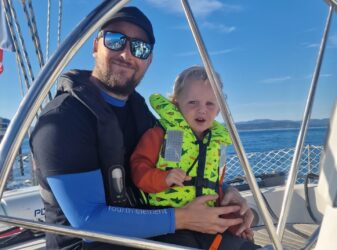
We couldn't find a skipper available to come with us, so this genuinely was our first voyage, on a 56-footer, with limited experience between us. The forecast wasn't kind, and we watched other boats turning back into the marina as we headed out, which did nothing for our nerves. St. Mandrier's bay gave us some shelter at first, but once we cleared it, the waves built, the wind picked up, and we ended up motoring the whole way with the sails stowed. Seasickness hit hard, and looking after the kids through it all felt like the hardest part of the whole trip. Reiss held it together and got us through to shelter, and eventually into Le Lavandou, docking a 56-footer for the first time being the last real hurdle of an already exhausting day.
The honest lesson here: your first passage on a new boat, especially a big one, will teach you more in a few rough hours than months of reading ever could. If you can get a skipper or experienced crew aboard for those first legs, take it. We couldn't, and we got through it, but it was harder than it needed to be.
Le Lavandou: Glorious in Summer, Quiet in Winter
Le Lavandou was a genuine relief after the dust of St. Mandrier, but a few weeks in we hit a wall: the town shuts down hard once the summer season ends. Half the shops closed, the pace changed completely, and it stopped being the buzzing base we'd arrived to. Fair enough, the locals work hard all summer and earn the break, but it meant Le Lavandou wasn't going to work as a longer-term winter base for us.
If you're planning to base anywhere on this coast outside peak season, check what's actually open before you commit. A marina that's perfect in July can feel like a ghost town by November.
Finding a Winter Marina Closer to the Airport
Reiss still had work commitments that meant regular flights, and the nearest airport from Le Lavandou was a three-hour drive away. We contacted around ten marinas looking for something closer. Half didn't reply at all, the other half were fully booked for winter, and our boat's size narrowed the options further, most marinas only hold a handful of berths that can actually fit a boat like Bolongo.
Port Gallice in Antibes came through with a spot. Not as close to the airport as we'd hoped, but a massive improvement on a three-hour drive, and close to Nice airport for crew changes and flights.
Worth knowing if you're planning a similar move: winter berth availability on this coast is genuinely tight, especially for anything over about 45-50 feet. Start calling marinas well before you need the spot, and don't assume a reply will come quickly in the off season.
Our Passage: Le Lavandou to Antibes
Once the weather cooperated, we set off for Antibes. Early evening brought one of those moments you sail for: dolphins appeared alongside the boat, leaping and diving as the light went golden, and watching our kids see dolphins for the first time from their own boat is one of those memories that makes the whole lifestyle make sense.
With no rush to make port before dark, we picked out a small island with a sheltered-looking anchorage for the night. Naturally, everything took longer than planned, and by the time we were ready to drop the hook, twilight had properly set in. It was our first time anchoring somewhere unfamiliar, on a 56-footer, with limited experience communicating as a crew, and it took a couple of attempts before it held properly. We got there in the end, and it's exactly the kind of learning curve every new boat owner goes through somewhere on their first season.
Places to Visit and Anchorages Along the French Riviera
Beyond our own two legs, this coast has some of the best-known cruising stops in the Mediterranean. Here's what's worth building into a Riviera route.
The Hyères Islands (Porquerolles, Port-Cros, Île du Levant), just off Toulon and close to where our own journey started at St. Mandrier, are genuinely some of the most beautiful anchorages on this whole coast. Porquerolles is largely car-free with turquoise water and excellent beaches, and Port-Cros is a protected national park with strict anchoring rules worth checking before you arrive.
Saint-Tropez and the Gulf of Saint-Tropez need no introduction. The anchorage off Pampelonne Beach is stunning and extremely busy in peak summer, arrive early or consider the quieter town of Sainte-Maxime across the bay if you want the same scenery with fewer superyachts crowding the anchorage.
Cannes, with its Vieux Port right in the heart of town, sits close to the Îles de Lérins (Sainte-Marguerite and Saint-Honorat), two small islands with genuinely good, more sheltered anchorages a short sail from the city.
Golfe-Juan and Antibes, where our own route ended, offer real variety: Port Gallice, where we based ourselves, sits toward Cap d'Antibes, while Port Vauban in Antibes town is one of the largest marinas in Europe and a well-known superyacht hub if you want to be right in the old town. The anchorages around Cap d'Antibes itself are worth a stop before or after a marina night.
Nice, along the Baie des Anges, has a city marina and an easy, walkable old town right at the waterfront.
Villefranche-sur-Mer, just east of Nice, is one of the best natural deepwater anchorages on the entire Riviera, a genuinely stunning bay that's sheltered enough to be a reliable overnight stop.
Monaco is iconic and eye-wateringly expensive to berth in, but worth a stop even briefly if it's within budget, or simply worth sailing past close enough to take it in.
Menton, right at the Italian border, makes a natural final stop on the French side before continuing into Italian waters.
Marinas Worth Knowing on This Route
- St. Mandrier (near Toulon) – working harbour area, useful but not a scenic base
- Le Lavandou – excellent in summer, largely closed down off-season
- Port Gallice, Antibes – smaller, well-placed near Cap d'Antibes, close to Nice airport
- Port Vauban, Antibes – large, central, superyacht-heavy
- Nice – central, walkable, busy
- Villefranche-sur-Mer – primarily an anchorage rather than a marina base, exceptional shelter
- Monaco – premium pricing, iconic location
- Menton – final French stop before Italy
What We'd Do Differently
Knowing what we know now, we'd have tried harder to get an experienced skipper aboard for that very first passage out of St. Mandrier, rough weather and a big unfamiliar boat is a lot to take on with zero miles under your belt. We'd also have started calling ahead for winter marinas earlier rather than working through a list of ten in a scramble, availability on this coast tightens fast once the season turns.
FAQ
Is the French Riviera a good place to learn to sail a bigger boat? It's where we did exactly that, and it works, but conditions can turn quickly and marinas get busy. If it's genuinely your first time on a new or larger boat, bringing an experienced skipper for the first passage or two makes a real difference.
Do marinas stay open on the French Riviera in winter? Many summer-focused towns wind down significantly off-season, some facilities close and the atmosphere changes completely. Bases closer to Nice and Antibes tend to stay more active year-round, partly due to airport access for crew changes.
What's the best anchorage on the French Riviera? Villefranche-sur-Mer is widely regarded as one of the best natural deepwater anchorages on the coast. For a quieter alternative to Saint-Tropez in peak season, Sainte-Maxime across the bay is worth considering.
How far ahead should I book a marina berth on this coast? For anything over roughly 45-50 feet, book well in advance, especially in winter when far fewer berths are available for larger boats and response times from marinas can be slow.